Políticas da percepção
Ricardo Basbaum
Observação: Durante muitos anos considerei a possibilidade de reinstaurar o espaço de pesquisa que envolve a delicada operação de duvidar das sensações interfaceantes com o mundo. Esta operação jamais poderia deixar de ser um hiper-cézannismo, se aceitarmos como dados nosso bio-corpo estruturado num sujeito pensante vitorioso e a atualidade obsessiva da experiência sensorial, sempre insatisfeita a tudo reconduzir a um grau zero. Mas tudo indica... [interrompe-se o raciocínio, tive que sair apressado] ...que esta situação está sendo substituída por outra, mais radical, em que não há uma referência segura para valorar a sensorialidade em sua pretensa pureza. Torna-se necessário formular uma corporiedade estranha, esquizo, mutante, para arbitrar um contorno - não mais humano, no velho sentido - que irá daqui para frente nos des-formatar sem qualquer retorno possível a um referente estável. Esta é a modalidade de espaço que devemos pensar - sobretudo os artistas, a quem se propõe a tarefa de investir decisivamente na condução desta investigação: as regiões sobre e sob a pele; os lugares de inversão dentro-fora, transformando a sensação em tópico submetido a variados debates, a rodadas de intensa negociação; a subjetividade como resistência enquanto produção de uma espacialidade que se quer externa, compartilhada, em trânsito (daí a importância dos grupos, estes corpos coletivos de multiplicação dos corpos também em suas imponderabilidades)... [uma noite mal dormida, em lugar estranho] ...os órgãos dos sentidos renegociando a economia do corpo através da redistribuição de intensidades; a arquitetura produzindo efeitos que provocam o corpo e, estando a experiência proposta pela artista também mergulhada na dimensão arquitetônica, há uma multiplicação das tensões espacializantes, isto é, a instalação tensionada pelo lugar pressiona os corpos dos visitantes (surgem novos espaços onde não se previa); etc. O impacto dos textos junto da experiência de encapsulamento proposta seria tanto reter por instantes o fluxo das sensações quanto potencializá-las. Isto é, espera-se que a leitura - ainda que ágil - não assuma um papel dominante no processo, mas que encontre um registro de inserção a partir dos assuntos articulados pelo projeto como um todo (alguns já referidos aqui: arquitetura, pele, corpo, dentro-fora, espaço ‘entre’, regiões de abertura e fechamento, entre outros)... [momentos de satisfação ao sair à varanda e sentar-me ao sol, de olhos semi-cerrados] ...até que ponto seria legítimo intervir em certas etapas da proposta?
Políticas da percepção: sinopse de projeto de trabalho
A quem se aproxima da mecânica do sentir são colocadas, entre outras, as seguintes questões:
- quem é produzido a partir da sensação que torna o corpo existente, despertando-o? (há um desvio, inevitável, próprio da não linearidade do processo em questão)
- este algo ou alguém surgido neste processo de produção é indicativo de qual modalidade de espacialidade? (seja em termos de interface interiorizante ou exteriorizante)
- como a percepção pode ser articulada subjetivamente enquanto lugar de negociação de poder? (trata-se de acentuar o delineamento de toda uma psicologia individual constantemente posta em crise pelas demandas de atualização do sentir, assim como de enfatizar o quanto as sensações são resultado de uma negociação coletiva pelos agenciamentos institucionais das sociedades contemporâneas, tendo o corpo como superfície e suporte de sua manifestação - sem esquecer que uma política da percepção coloca o lugar da sensação como região permeável à economia do ‘controle’, este atualmente uma espécie de algoritmo regulador disseminado no sistema de modo descentrado, insinuando-se em rede.
..................................................................................
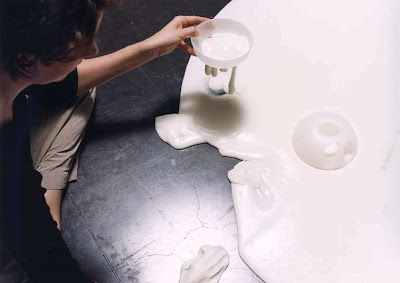
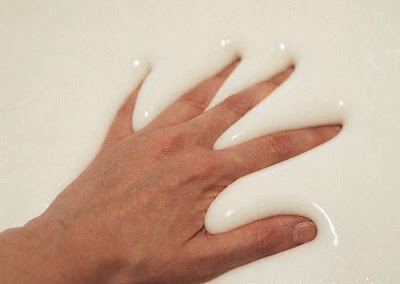
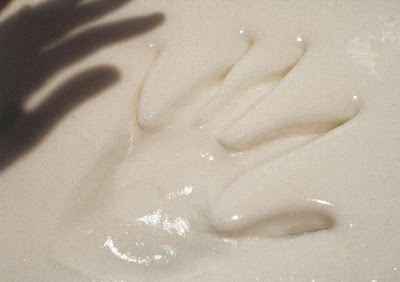
Dois painéis brancos, um mais longo, outro mais curto, de superfícies contínuas, interrompidas de quando em quando por pequenos orifícios desenhados para acoplamento específico de certas partes do corpo: dedos das mãos, ouvidos, olhos. As interrupções são mínimas, não ameaçando a integridade das superfícies, de modo que os painéis se impõem também como objetos, isto é, coisas que se tridimensionalizam, ocupam lugar no espaço. Por isso há também algo de escultórico, embora - mais uma vez - uma presença escultórica rarefeita, lateral e quase invisível. Quem se aproxima destes objetos-superfícies desliza e derrapa na grande quantidade de branco, como se tocasse o corpo numa área extremamente lisa, de atrito quase zero: aquele que encosta é lançado à frente, praticamente na mesma velocidade em que veio (vale lembrar: atrito quase zero). Entretanto estão lá, presentes, as interrupções, estrategicamente colocadas: nestes pequenos orifícios os corpos literalmente se engancham, prendem, acoplam aos painéis brancos: os dez dedos das mãos; o ouvido esquerdo ou direito; os olhos, em visão binocular. Esta captura é um dos pontos nodais do trabalho (há outros, numa intrincada economia interna): o espectador capturado torna-se permeável e sofre decidida e delicada intervenção – um tipo de espessamento e alargamento, reviramento e habitabilidade (ou colonização) das interfaces sobre e sob a pele. Estes gestos são apenas o início de um processo, que ainda vai multiplicar sua eficiência e condições de envolvimento sobre a corporeidade dos que se aproximam. “Desocupado” e “Parede”, dois objetos-superfícies - o primeiro de maior extensão (13,67 x 5,16 m e 3,00 x 1,83m, respectivamente, sempre com altura de 2,50m), ambos em forma de ‘L’ - tomam para si parte das demandas em jogo, desempenhando papéis que se complementam: “Desocupado” é, sem dúvida, o mais surpreendente: as laterais abrem-se em portas de entrada e saída, oferecendo o seu avesso para ser explorado - convite (compulsório) para uma travessia, um passeio dentro de sua estrutura. As pequenas descontinuidades e interrupções notadas inicialmente ganham presença multiplicada no conjunto das ações induzidas, em que o lado de dentro é experimentado enquanto superfície conectada ao lado de fora. Uma vez dentro do painel, uma série de experiências são propostas durante a travessia: surgem novamente interrupções nas superfícies (agora do lado de dentro, logo há uma inversão), convidando ao acoplamento de dedos, ouvidos e olhos; surgem desenhos e textos, oferecendo elementos complementares às situações de acoplamento, fazendo da experiência da travessia também algo que acontece sob a reverberação de linhas e palavras (imagens de vibração do corpo, discurso acerca do espaço e seus intervalos); depara-se com a possibilidade de ver além-corpo, através das paredes, quando é aberta uma passagem através do vidro detrás do painel em que se descortina a paisagem urbana, além do local em que estamos; entra-se em outra área, já próxima de um fim de percurso, em que são despejados sons de um outro lugar – a possibilidade de ouvir além-corpo; por fim, a saída e, junto com ela, as sensações persistentes, as perguntas: estivemos dentro de que, dentro de quem, dentro de onde? “Parede” nos acrescenta uma experiência a mais, no percurso do conjunto (não que os acoplamentos ali propostos sejam iguais, mas que irão se dar a partir desta variação, deste dado novo): junto ao chão, quase na base deste igualmente objeto-superfície, um orifício se abre para apresentar dois moldes (que podem ser tocados, examinados, olhados), em acrílico. É significativo que tenham sido produzidos a partir de um gesto de tapar os olhos com as mãos, e que este não-ver que propõem acaba por configurar um outro ver (mais correto: um ver-outro), pois os moldes tornam visível, concreto, material, o espaço físico entre as mãos e os olhos: um lado do molde guarda a impressão dos dedos, outro lado a impressão do olho; o que se imprime de um lado e outro é sempre a pele, mas o objeto só resulta devido às forças de pressão do tônus muscular. Estratégia de materialização do ‘entre’, aqui não por acaso construído a partir das sensações do tato e do olhar: estrategicamente, são um gesto de anestesia que repotencializa o sensível. Na região central da instalação há um impressionante acúmulo de gel especialmente preparado que se oferece à manipulação: “Musa” é a materialização do informe, incapaz de reter qualquer gesto. Pode parecer frustrante que as vontades que se colocam sobre ela não resultem em qualquer cristalização que possa ser compartilhada (não há tempo de contar ao outro o que estamos fazendo ou queremos fazer) - produz-se uma estranha solidão. Mesmo os objetos ali presentes (que nos relembram mais uma vez de possíveis acoplamentos) não adicionam qualquer utilidade mais imediata (seria esta experiência basicamente uma de desorganização, desmontagem?); somos colocados frente a um segundo ponto nodal de todo este processo: sem que seja escamoteado o risco envolvido na operação, é valorada a experiência do informe como algo constitutivo, etapa de um processo, lugar de conquista (o participante é pressionado a como se situar ali em volta). Cada etapa de todo este projeto procura indicar que não há recuo algum em deixar-se dissolver, oferecer-se à remodelação. Mas um dos principais temas aqui não é mesmo a condição de estar aberto aos processos; a situação que se insinua é aquela da quebra de resistências e da invasão compulsória (aspectos desta intrincada negociação).
P.S. Em que medida se deve levar em consideração a demanda institucional envolvida, isto é, a consciência da presença de toda a estrutura do trabalho num lugar preparado previamente para receber a situação arte (Museu)? Creio ser importante ressaltar a ambiguidade com que esta questão é tocada: se por um lado a utilização dos painéis de exposição revela extrema agilidade de inserção, isto é, estar presente na instituição por dentro mesmo de sua estrutura, invisivelmente, tendendo ao quase desaparecimento (poucas propostas jamais fizeram isto tão literalmente, de maneira tão generosa e com tamanha eficiência) – nesse sentido o trabalho pode ser visto mesmo como proposta de habitação e transformação de algumas das camadas aí envolvidas - , por outro esta presença é minimizada de forma decisiva e concreta, quando todo o jogo de sedução do visitante se dá através da pele – superfície – e este visitante aparece descolado de uma obrigação mais direta de percepção institucional para envolver-se com as demandas da sensorialidade imediata, ou seja, o trabalho igualmente limita, neutraliza e reduz a ação-museu (felizmente no momento exato, antes que aquele corpo esteja invariavelmente entregue às obrigações de registro em território mapeado e localizado no já visto e vivido). Se a instalação balança entre estes pólos, quem chega a ela é igualmente sacudido no mesmo reviramento.
..................................................................................
...até que ponto seria legítimo intervir em certas etapas da proposta?
Momentos de beleza e tensão podem ser gerados quando um artista estabelece conexões com o trabalho do outro. Trata-se de um caminho de “crítica interna”, do intercruzamento de substâncias através da matéria e através dos tempos. Com a brevidade e o cuidado que o momento exige, seguem aqui alguns rápidos apontamentos com os quais conecto meu esforço de pesquisa com o projeto comentado acima. Que fique bem claro o quanto esta minha proposta possui de invasividade e intrusão; e o quanto o trabalho de que falamos se abre para receber múltiplos acoplamentos, muito mais do que podemos imaginar neste momento – daí a necessidade de se confiar ao tempo, em seus aspectos de imprevisibilidade, a perspectiva que ultrapassa o meramente computável e descritível.
..................................................................................
Experiência nº1:
Um grupo de 12 pessoas aproxima-se de “Desocupado”, com uma proposta de ação coordenada (três crianças, quatro homens, cinco mulheres): cinco entram imediatamente pelo avesso da peça (três homens e duas mulheres), sete permanecem no exterior. Dos cinco que entraram, uma das mulheres imediatamente avança até quase a saída, colocando-se junto às caixas de som, atenta aos ruídos captados à distância pelos microfones (ouvindo além-corpo), de olhos fechados, sem ler o texto; dois homens acoplam-se aos ‘fones’, igualmente de olhos fechados, atentos aos textos (decidem abrir os olhos de quando em quando, para certificarem-se de onde realmente estão); o último homem e a última mulher deste grupo decidem compartilhar o mesmo local, dividindo as ações de acoplamento propostas: ele se acopla ao painel pelos dedos, ela pelos olhos. Resolvem conversar bem baixinho um com o outro (sua intenção é não interferir nas experiências dos outros três, mas ocorre que as vozes também ocupam o espaço interno dos painéis, ainda que como leve sussurro), ela descrevendo o lado de fora do prédio (vendo além-corpo), ele descrevendo o desenho (suas palavras se tocavam em algum ponto da conversa?). Permanecem do lado de fora sete pessoas (um homem, três mulheres, três crianças), que se distribuem da seguinte maneira: duas crianças correm para se acoplar através dos ouvidos e permanecem em seus lugares paradas, ainda que inquietas revirando os olhos. Duas mulheres igualmente posicionam seus ouvidos junto aos fones e seu gesto mais imediato é fechar os olhos; uma delas concentra-se longamente na experiência, fruindo a sonoridade em detalhes, outra carrega no colo a terceira criança (muito nova) e todo o tempo procura relacionar as sensações do som com as expressões faciais e movimentos corporais da criança (descobertas em potencial estão aí envolvidas). Um casal de adultos não interage diretamente com a peça, permanecendo em torno, atento às reações dos outros, tendo sua curiosidade aguçada pouco a pouco. O que se gostaria de saber é que tipo de gesto cada um quer executar junto à “Desocupado”, pois não conversam um com o outro sobre isso, apenas trocam olhares.
Experiência nº2:
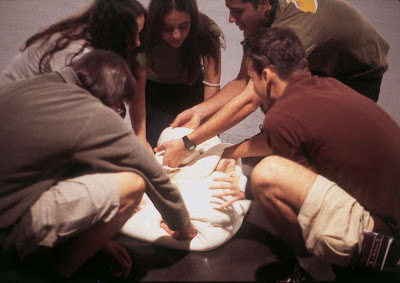
Três homens e três mulheres sentam-se em torno de “Musa” e passam cerca de 15 minutos tocando o gel, manuseando-o de diversas maneiras. Sugere-se que troquem pedaços entre si, procurando passar um ao outro algum tipo de forma antes que esta se dissolva. Após este tempo, alguém (homem ou mulher) deve sugerir um assunto de cunho pessoal (ainda que fictício) para ser conversado pelo grupo durante 15 minutos. Quem estiver falando deve estar ao mesmo tempo mexendo no gel com ambas as mãos.
Politics of perception
Ricardo Basbaum
Note: For many years I considered the possibility of reinstating space for research involving the delicate act of doubting the sensations that form an interface with the world. This could only ever be a kind of hyper-cezannism, if we accept our bio-body structured within a thinking, victorious subject and the current obsessive actuality of sensory experience, always dissatisfied in leading everything back to a point zero. But everything points … [the thought-process is cut, I had to rush out] ... to the fact that this situation is being replaced by one that is more radical, where there is no safe reference by which to evaluate sensibility in its supposed purity. It becomes necessary to formulate a strange, schizo, mutant corporality to arbitrate the contours - no longer human in the old sense - that will from now on de-format us, doing away with any chance of a return to a stable point of reference. It is this type of space that we must consider - most of all, artists, whose task it is to invest decisively in leading this investigation: the regions on and under the skin; the places of inversion inside-out, making the senses a topic of varied debate, of rounds of intense negotiation; subjectivity as resistance in the production of a space intended to be external, shared, in transit (herein lies the importance of groups, these collective bodies of multiplicities of bodies, also including their imponderabilities)... [a sleepless night in an unfamiliar place] ... the sense organs renegotiating the body's economy by redistributing intensities; architecture producing effects that provoke the body, and, as the experience proposed by the artist is also deep within the architectural domain, there is a multiplication of spatial tensions, i.e. the installation, rendered with tension by the place, exerts pressure on the body of the visitors (new spaces reveal themselves unexpectedly); etc. The impact of the texts together with the proposed experience of being encapsulated works both to retain momentarily the flow of sensations and to potentiate them. In other words, it is hoped that the reading - even if fleeting - does not take a dominant role in the process, but that it finds a register by which to be inserted from the subjects expressed by the project as a whole (some already mentioned here: architecture, skin, body, outside-inside, space 'in-between', regions of opening and closing, among others) ... [moments of satisfaction as I go out onto the balcony and sit in the sun with my eyes half shut]... up to what point would it be valid to intervene in certain stages of the proposal?
Politics of perception: synopsis of a work project
The following questions are put to those who approach the mechanics of sensing:
- who is produced from the sensation that brings the body into existence, awakening it? (there is an inevitable diversion inherent in the non-linearity of the process in question);
- what type of spatiality is this something or somebody arising within this production process indicative of? (be it in terms of an interiorizing or exteriorizing interface);
- how can perception be coordinated subjectively as a place for negotiating power? (it is a matter of accentuating the portrayal of a whole individual psychology that is repeatedly put in crisis by the constant updating that sensations impose, as well as emphasizing how much sensations are a result of a collective negotiation by institutional solicitations of contemporary societies, with the body as the surface and support of its manifestations - without forgetting that a politics of perception places the senses in a region permeable to the economy of 'control', which is currently a kind of regulating algorithm disseminated through the system in a decentered way, spreading out like a network).
..................................................................................
Two white panels, one longer, the other shorter, of unbroken surfaces, interrupted at intervals by small orifices specifically designed for certain parts of the body to connect: fingers, ears, eyes. These interruptions are minimal, in no way compromising the wholeness of the surfaces, so that the panels also impose themselves as objects, things that three-dimensionalize themselves, occupy a place in space. For this reason, there is also something of the sculptural, though - once again - a rarefied sculptural presence, lateral, almost invisible. S/he who approaches these objects/surfaces slides and slips on the abundance of white, as if touching an extremely smooth part of a body, a part with almost zero friction, where an object that touches it rebounds forwards at almost the same speed at which it came (the effect of zero friction). However, the interruptions are there, present, strategically placed. In these small orifices, bodies literally hook on, attach, couple to the white panels: the ten fingers of one's hands; the left or right ear; the eyes, in binocular vision. This capturing is one of the nodal points of the piece (there are others, in an intricate internal economy): the captured spectator becomes permeable, undergoing a decided yet delicate intervention - a type of thickening and widening, reversal and habitability (or colonization) of the interfaces on and under the skin. These gestures are just the start of a process which will further multiply its efficiency and conditions for involving the corporality of those that come near. "Desocupado" [Unoccupied] and "Parede" [Wall], two surface-objects - the first longer (13.67 x 5.16 m and 3.00 x 1.83m, respectively, always with the same height of 2.50 m), both in an L shape - take on part of the demands in play, assuming roles that complement each other. "Desocupado" is, without doubt, the most surprising: the sides open up into doors for entry and exit, offering its nether regions for exploration - an invitation (compulsory) for a crossing, a journey within its structure. The small discontinuities and interruptions initially noted gain a greater presence in the set of actions that are induced, where the inside is experienced as a surface connected to the outside. Once within the panel, a series of experiences are offered during the journey: interruptions are present again on the surfaces (now inside, so there is an inversion), inviting fingers, ears and eyes to bond; drawings and texts appear, offering complementary elements for the bonding situations, also allowing the experience of crossing to reverberate under the effect of lines and words (images of body vibrations, discourse about space and its intervals); one comes across the possibility to see beyond the body, through the walls, when a passage through the glass behind the panel is opened up, unveiling the urban landscape, as well as the place where we are; one enters another area, now near the end of the route, into which sounds from another place are poured - the chance to hear beyond the body; finally, the exit, and with it the lingering sensations, the questions: what have we been inside, who, where? "Parede" adds a further experience to the journey through the pieces (not that the bonding offered here is the same, but it will come about from this variation, from this new event): near the ground, almost at the base of this likewise object-surface, a hole opens up to present two moulds (which can be touched, examined, looked at) in acrylic. It is of relevance that they were produced from the gesture of covering the eyes with the hands, and that this not-seeing that they propose ends up shaping another kind of seeing (more precisely, a see-other), since the moulds make the physical space between the hands and the eyes visible, concrete, material: on one side of the mould there is the impression of fingers, on the other, the impression of an eye; what is impressed on one side and the other is always the skin, but the object can only result from pressure applied by muscular tone. A strategy of materialization of the 'in-between', brought into being here, not coincidentally, from the senses of touch and look: strategically, they are a gesture of anesthesia that revitalizes the senses. In the central part of the installation, there is an impressive mass of gel specially prepared to be handled: "Musa" [Muse] is the materialization of the formless, incapable of retaining any gesture. It could seem frustrating that the will imposed on her results in no crystallization whatever that can be shared (there is no time to tell anybody else about what we are doing or what we want to do) - inducing a strange solitude. Even the objects present there (that once again remind us of possible coupling) do not add any more immediate utility (could this basically be an experience of disorganization, disassembly?). We are placed before a second nodal point of this whole process: while the risk involved in the operation is not removed, the experience of the formless as something constructive, a stage in a process, a place of conquest, is valued (the participant is under pressure as to how to position him/herself around it). Each stage of this whole project seeks to point out that it is by no means a backward step to allow oneself to dissolve, to offer oneself for remodeling. But one of the main themes here is not exactly the condition of being open to processes: the situation that emerges is one of breaking resistance and compulsory invasion (aspects of this intricate negotiation).
P.S. How far should the institutional demands involved be taken into consideration, in other words, the awareness of the presence of the whole structure of the work in a place prepared in advance to receive the art situation (Museum)? I believe it is important to highlight the ambiguity with which this issue is dealt: if, on the one hand, the utilization of the exhibition panels reveals in them a great capacity for insertion, i.e. presence in the institution, within its actual structure, invisibly, tending almost towards disappearance (few works have ever done this so literally, so generously and with such efficiency) - in this sense the work may even be seen as a proposal of habitation and transformation of some of the layers involved - , on the other, this presence is minimized decisively and concretely when the whole game of winning over the visitor takes place through the skin - surface - and this visitor seems relieved of any more direct obligation of institutional perception to involve himself with the demands of the immediate sensoriality. In other words, the piece at the same time limits, neutralizes and reduces the action of the medium (luckily at the right moment, before that body is invariably set on its mandatory path of registering mapped out territory located in the land of the already seen, already experienced). If the installation swings between these poles, whoever comes to it is likewise shaken in the same movement.
..................................................................................
...up to what point could it be justified to intervene in certain stages of the proposal?
Moments of beauty and tension can be generated when an artist builds up links with the work of another. This is a route of "internal criticism", of the interchange of substances through matter and through time. Retaining the brevity and care that the moment demands, here follow a few quick points through which I connect my research effort to the project commented on above. May it be quite clear to what extent this proposal of mine is invasive and intrusive; and to what degree the work of which we speak opens up to receive multiple bonding, in many more ways than we may yet imagine. And for this reason one must trust to time, with all its unpredictability, the perspective beyond that which is merely computable and describable.
..................................................................................
Experience nº1
A group of 12 people approach "Desocupado", with the purpose of a coordinated action (three children, four men, five women); five immediately enter the inside of the piece (three men and two women), seven remain outside. Of the five that enter, one of the women immediately walks almost as far as the exit, placing herself next to the loudspeakers, paying attention to the sounds captured from a distance by microphones (hearing beyond the body), eyes shut, without reading the text; two men attach themselves to the 'mini-speakers', likewise with shut eyes, paying attention to the texts (they decide to open their eyes from time to time to check where they really are); the last man and woman of this group decide to share the same place, sharing the bonding and coupling offered: he bonds onto the panel through his fingers, she through her eyes. They exchange words very quietly (they intend not to interfere with the experiences of the other three, but it so happens that their voices also occupy the internal space of the panels, though as a quiet whisper), she describing the outside of the building (seeing beyond the body), he describing the drawing (do their words meet at some point in the conversation?). Seven people stay outside (one man, three women, three children), placing themselves as follows: two children run to link on through their ears and stay still where they are, although their eyes roam restlessly. Likewise, two women place their ears next to the mini-speakers and their most immediate gesture is to close their eyes; one of them concentrates on the experience for a long time, enjoying the sonority in detail, while the other carries a third child (very young) and constantly seeks to relate the sensations of the sound to the facial expressions and body movements of the child (discoveries in potential are involved here). An adult couple does not interact directly with the piece, standing nearby, paying attention to the reactions of the other people, their curiosity being aroused little by little. What one would like to know is what type of gesture each person feels compelled to make with "Desocupado", as they do not talk to each other about this, only exchange looks.
Experience nº2
Three men and three women sit around "Musa" and spend around 15 minutes touching the gel, handling it in different ways. It is proposed that they swap portions, trying to pass to each other some type of shape before it loses its form. After this, somebody (man or woman) must suggest a subject of a personal nature (even fictitious) to be talked about by the group for 15 minutes. Whoever is talking must be handling the gel with both hands as they speak.